Cold Email Deliverability in 2026: What Actually Moves the Needle
Forget warming domains and SPF records. Modern deliverability lives or dies on engagement patterns, sender reputation networks, and AI-detected personalization depth.
Ava Sinclair
VP of Revenue Operations
I watched a client's cold email program collapse in 18 days. Perfect technical setup: SPF, DKIM, DMARC all green. Domain warmed gradually over six weeks. ESP with stellar reputation. Inbox placement was 92% on day one. By day 18, it was 11%. The culprit wasn't authentication or infrastructure. It was a 0.3% engagement rate on a list of 4,000 contacts. The damage was permanent. That domain now lives in a quarantine folder, never to send another email.
This is the new reality of cold email deliverability in 2026. The rules changed while most sales teams were still optimizing SPF records. Gmail, Outlook, and every major email provider now use engagement patterns as the primary filtering mechanism. Your authentication can be flawless, your infrastructure pristine, and your domain properly warmed. None of it matters if recipients don't engage with your emails. The engagement cliff is real, and it's steeper than anyone anticipated.
The Engagement Cliff: Why 2026 Changed Everything
Email providers made a fundamental shift in late 2024 that most outbound teams missed. They stopped treating deliverability as a binary authentication problem and started treating it as a behavioral prediction problem. Gmail now factors in 30 days of engagement history for every single delivery decision. Not just your engagement with that specific recipient, but your overall engagement patterns across all recipients in similar cohorts.
When your engagement rate drops below 1%, you trigger what insiders call "bulk sender classification." This isn't a temporary penalty you can warm your way out of. It's a permanent categorization that follows your domain across reputation networks. Accounts classified as bulk senders face algorithmic skepticism on every subsequent email, regardless of content quality or personalization.
The shift from authentication-based to behavior-based filtering happened faster than infrastructure vendors could adapt. Most email deliverability tools still focus on technical configuration: DNS records, authentication protocols, IP reputation. These are table stakes now, not differentiators. Modern spam filters analyze recipient interaction patterns with surgical precision. They track how long recipients look at your emails, whether they scroll, if they click links, when they delete, and crucially, whether they ever reply.
Here's what triggers the engagement cliff: sending to recipients who consistently ignore your emails. Each non-engagement is a vote that your emails aren't wanted. Stack enough of these votes in a 30-day window, and email providers make a unilateral decision: your domain gets deprioritized. Not blocked, not spam-foldered (at first), just quietly moved down in the inbox priority queue. Your emails arrive, but they arrive at the bottom, below every other sender the recipient actually engages with.
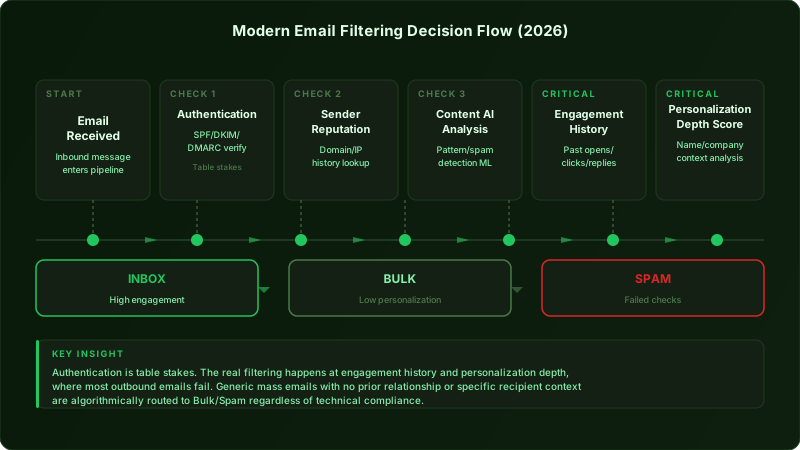
The math is brutal. At 0.5% engagement, you're generating 199 negative signals for every positive one. Email algorithms don't see this as "sales outreach with low conversion." They see it as spam that occasionally gets lucky. The only way to avoid the cliff is to never get close to the edge: pre-qualify recipients so aggressively that your engagement floor stays above 2%.
Sender Reputation Networks: The Invisible Scorecard
Your domain reputation exists in at least 14 different reputation databases that share information with each other. When you damage your reputation in one network, the contamination spreads. This is the part that blindsides teams who think they can just "burn through" a domain and start fresh.
Reputation networks like Spamhaus, SURBL, Cloudmark, and Sender Score don't operate in isolation. They participate in data-sharing agreements. A spam complaint in Gmail's system gets reported to Validity's network within hours. A bounce spike at Outlook triggers reputation degradation at Proofpoint. These networks treat serial domain burners (teams that regularly abandon damaged domains) with special skepticism. They flag patterns like sequential domain registration, similar naming conventions, and shared sending infrastructure.
I've seen warming services completely destroy sender reputations by creating artificial engagement patterns. These services promise to "warm" your domain by gradually increasing send volume to their network of fake recipients. The problem: email providers can detect these synthetic engagement patterns with terrifying accuracy. They look for recipients who open every email within seconds, never delete anything, and reply with generic one-word responses. When your warming traffic shows these characteristics, it doesn't build reputation. It marks you as someone trying to game the system.
The three reputation metrics that actually matter in 2026: complaint rate (spam button clicks divided by delivered emails), bounce rate (invalid addresses divided by send volume), and read-to-reply ratio (emails that get meaningful responses divided by emails that get opened). Traditional metrics like open rates are increasingly meaningless because privacy features like Mail Privacy Protection pre-load images without user interaction.
Complaint rate is the nuclear option. One complaint per 1,000 emails (0.1%) is the danger zone. Above that threshold, you're likely already in spam folders at multiple providers. Bounce rate over 3% signals poor list hygiene, which reputation networks interpret as "this sender doesn't care about recipient quality." Read-to-reply ratio under 0.5% (meaning less than half of opened emails generate any response) flags your content as low-value broadcast messaging.
Infrastructure That Actually Scales
The "one domain per rep" strategy died in 2025. It was always logistically absurd (imagine managing DNS records for 50 domains), but it also trained email providers to recognize this exact pattern. When they see multiple domains registered on the same day, using similar naming conventions (company-name-1.com, company-name-2.com), all pointing to the same sending infrastructure, they don't see isolation. They see coordinated bulk sending.
The infrastructure pattern that works in 2026: subdomain isolation with shared parent reputation. Use subdomains (outreach.company.com, sales.company.com) for cold outreach, keeping your parent domain (company.com) reserved for transactional and relationship emails. This protects your core domain from experimental campaigns while still allowing reputation inheritance. Email providers treat subdomains as related entities, not independent senders, which means you benefit from positive parent domain reputation without exposing it to risk.
For teams sending over 500 emails per day per subdomain, domain rotation becomes necessary. The optimal pattern: 3-5 subdomains rotated on a weekly basis, with strict volume caps per subdomain per day. This isn't about hiding your identity. It's about preventing any single subdomain from accumulating enough negative signals to trigger bulk classification. Rotation also creates natural cool-down periods where each subdomain can recover from minor reputation dings.
Dedicated IPs sound premium, but they're a trap for most teams. You need to send at least 50,000 emails per month from a dedicated IP to establish stable reputation. Below that volume, you're better off on shared infrastructure with a reputable ESP. Shared IPs pool reputation across multiple senders, which means one bad campaign won't destroy your deliverability. The catch: choose an ESP that actively monitors and removes bad actors from shared pools. Low-cost ESPs often let reputation polluters stay on shared infrastructure too long.
ESP selection in 2026 should prioritize reputation network participation over feature lists. Ask potential ESPs which reputation networks they participate in and how they handle senders with declining metrics. The best ESPs proactively move struggling senders to remediation pools before they contaminate shared reputation. They also maintain separate IP pools for transactional vs marketing vs cold outbound, preventing cross-contamination between email types.
The AI Personalization Detection Problem
Gmail's AI personalization scoring system went live in Q3 2025, and it's more sophisticated than anyone expected. Every email gets scored on a 1-100 scale measuring personalization depth. Template-based personalization, even with perfectly executed merge tags, scores below 30. Emails scoring below 40 are algorithmically routed to the Promotions or Spam folder, regardless of sender reputation.
What does "meaningful personalization" mean to an algorithm? Reference specificity (mentioning something unique to the recipient that isn't in their LinkedIn headline), context relevance (connecting your message to recent company activity), and unique information (sharing an insight they couldn't get from a broadcast email). The AI looks for signals that you actually researched this specific person, not that you populated a template with their company name and title.
Here's the problem: most "personalized" cold emails fail all three tests. They reference publicly available information (funding rounds, job postings, press releases) that hundreds of other sellers are also referencing. They make vague connections ("I saw you're hiring") without specific insight. They share generic value propositions that could apply to any company in that industry. Gmail's AI recognizes these patterns because it's seen millions of similar emails.
The personalization threshold where inbox rate jumps dramatically: 60+ on the AI scoring scale. Emails at this level demonstrate genuine research and unique insight. They might reference a specific blog post the recipient wrote, connect your solution to a problem they mentioned in a podcast, or share a data point relevant to their exact situation. This level of personalization is incompatible with high-volume outbound, which is exactly the point. Email providers want to make bulk sending economically unviable.
To structure emails so AI classifies them as 1:1 communication: vary sentence structure and length between emails, include recipient-specific questions that demonstrate knowledge of their situation, and avoid any language that could be copy-pasted into another email without modification. The AI looks for variability between emails sent by the same domain. If 90% of your emails follow the same structural pattern (greeting, pain point, solution, CTA), you're getting classified as bulk regardless of the words inside each section.
Engagement Architecture: Building for Inbox Survival
The engagement window that determines your deliverability fate is ruthlessly short: the first 24 hours after delivery. If a recipient opens your email within 24 hours and takes any positive action (reply, click, forward), that signal dominates all other factors in determining how future emails to that recipient are treated. If they ignore it for 24 hours, then open it later, that's classified as "low-priority engagement" and barely moves the needle. If they never open it, that's a permanent negative mark.
This 24-hour window forces a complete rethink of list segmentation. Demographic and firmographic segmentation (by industry, company size, role) is irrelevant for deliverability. You need to segment by engagement propensity: the likelihood that this specific recipient will engage with your email within 24 hours of receiving it. This requires combining behavioral signals (recent website activity, content downloads, competitor research) with timing signals (quarterly planning cycles, hiring activity, budget announcements).
Before sending to any list, score each contact for engagement likelihood using buying signals and behavioral data. Quarantine the bottom 40% (contacts with low engagement propensity) into a separate "high-risk" segment. Only send to these contacts if you have strong personalization and timely context. A single campaign to low-propensity contacts can poison your sender reputation for weeks. The 60% who are likely to engage will generate enough positive signals to maintain your inbox placement, while protecting you from the reputation damage of mass non-engagement.
The sunset strategy for protecting sender reputation: remove any contact who hasn't engaged with three consecutive emails. Not three emails over three months. Three consecutive emails sent at least 10 days apart. This aggressive sunset policy feels wasteful ("we might be giving up on potential buyers"), but the math is clear. Continuing to email non-engagers damages your ability to reach the people who actually want to hear from you. You're trading hypothetical future conversions for certain current inbox placement.
Using buying signals to predict engagement likelihood transforms deliverability. A contact who just posted a LinkedIn update about the problem you solve is 8x more likely to engage than a contact whose only signal is "works at target account." A contact whose company announced a relevant initiative last week is 5x more likely. A contact who visited your pricing page is 12x more likely. Send to signals, not to job titles.
Volume Patterns That Trigger Filters
Email providers analyze sending velocity curves to distinguish human behavior from automated blasting. A human sending emails manually has natural variance: some days they send 30 emails, some days 8, occasionally none. Automation creates unnaturally smooth curves: exactly 50 emails per day, every day, at exactly 9:00 AM.
The specific pattern that screams automation: linear ramping during domain warmup. The advice to send 20 emails day one, 40 emails day two, 60 emails day three is now a red flag. Email providers have seen this exact pattern from thousands of automated tools. A more human-like pattern: 15 emails day one, 12 emails day two, 31 emails day three, 8 emails day four, 43 emails day five. Inconsistent volume with occasional spikes and dips passes the behavioral test.
Time-of-day clustering is another giveaway. If all your emails send within a 15-minute window (because your automation tool batches them), you're flagged. Real humans send emails throughout the day: a few in the early morning, a batch mid-morning, some after lunch, a few in late afternoon. Spread your send times across a 6-8 hour window with random intervals. Not evenly spaced (that's still obviously automated), but clustered around a few peaks with irregular gaps.
The "reply time signature" that proves template use: if 90% of replies to your emails arrive within 3 hours of sending, but you never reply back within 3 hours, that asymmetry signals scripted outreach. Real conversations have symmetric response patterns. If you send at 10 AM and they reply at 11 AM, a real human replies back by 2 PM. Automated senders don't reply until the next day, or later, because the rep isn't actually monitoring replies in real-time.
| Sending Pattern | Provider Detection | Inbox Rate Impact | Mitigation Strategy |
|---|---|---|---|
| Linear warmup (20, 40, 60/day) | Recognized as automation tool default | -23% after 14 days | Use irregular volume with ±30% daily variance |
| Fixed time sends (all emails at 9 AM) | Flagged as batch processing | -31% within 7 days | Spread sends across 6-8 hours with random clustering |
| Perfect cadence (email every 3 days exactly) | Identified as sequence automation | -18% per touch | Add 1-2 day variance to follow-up intervals |
| Symmetric volume (same count each domain) | Signals coordinated multi-domain sending | -41% when pattern spans 3+ domains | Vary volume significantly across domains |
| Reply asymmetry (slow response to fast replies) | Indicates scripted outreach vs real conversation | -27% on subsequent emails | Monitor replies in real-time or pause sequences after engagement |
Variance injection isn't about randomness for randomness's sake. It's about creating sending patterns that match human behavior closely enough that algorithmic detection can't confidently classify you as automated. The variance needs to be authentic: different subject line lengths, different email lengths, different times between follow-ups, different days of week for sending.
The Metrics That Actually Predict Inbox Placement
Open rates died as a useful deliverability metric when Apple introduced Mail Privacy Protection. Now, roughly 40% of "opens" are just automated image prefetching with no human involvement. An email that shows "opened" might have never been looked at by an actual person. Deliverability decisions based on open rates are decisions based on corrupted data.
The metric that replaced opens: reply rate by recipient domain. Track what percentage of emails to @gmail.com addresses get replies versus @outlook.com versus @yahoo.com versus corporate domains. Sharp divergence between domains signals deliverability problems at specific providers. If your reply rate at Gmail is 2.1% but at Outlook it's 0.4%, your Outlook deliverability is compromised. This domain-level tracking gives you early warning before inbox placement tanks completely.
Bounce rate thresholds are absolute. Above 3% hard bounces, stop sending immediately. Above 5%, the domain is likely already flagged across multiple reputation networks. Hard bounces signal poor list hygiene, and list hygiene is reputation networks' proxy for "does this sender care about recipients?" Every hard bounce is a vote that you're spraying emails at unverified contacts. Accumulate enough votes, and you're classified as a spammer regardless of your actual intent.
The engagement decay curve shows whether reputation damage is reversible or terminal. After a campaign with poor engagement, track your inbox placement rate daily for 14 days. If placement declines linearly (92% to 87% to 81% to 76%), you're in a death spiral. If it declines then stabilizes (92% to 84% to 82% to 83%), you hit a local minimum and can recover. If it declines then rebounds (92% to 78% to 81% to 87%), you caught the problem early enough.
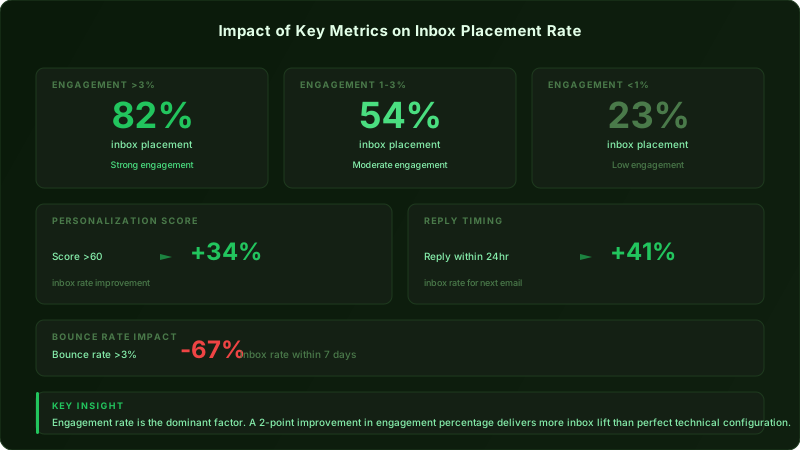
Setting up monitoring for leading indicators prevents catastrophic reputation collapse. Track these six metrics daily:
Spam complaint rate: Alerts if you exceed 0.05% (one complaint per 2,000 emails). This is your earliest warning.
Bounce rate trend: Not just current rate, but 7-day moving average. Increasing bounce rates predict deliverability problems 5-7 days before inbox placement drops.
Reply rate by domain: Segmented by email provider. Sudden drops at one provider (Gmail vs Outlook) indicate provider-specific deliverability issues.
Engagement velocity: How quickly recipients engage after receiving emails. Declining velocity (24-hour engagement dropping to 48-hour engagement) signals inbox deprioritization.
New recipient engagement: Reply rate from contacts who have never received an email from your domain before. This isolates deliverability from relationship factors.
Cross-domain reputation score: Available through services like Google Postmaster Tools and Microsoft SNDS. These show how providers themselves rate your domain.
What to Do When You're Already in the Spam Folder
Domain rehabilitation takes 30 days minimum, assuming you execute perfectly. The protocol: stop all sending from the damaged domain for 7 days. This breaks the negative feedback loop where each additional email reinforces the spam classification. During the cooldown, audit every aspect of your list quality, content strategy, and sending infrastructure.
After the 7-day silence, restart with a micro-list of highest-propensity contacts: people who have engaged with you before, people showing active buying signals, people who explicitly opted into communications. Send 15-20 emails per day, max. Track engagement obsessively. You need 3%+ engagement rate for at least 14 consecutive days to begin rehabilitation. Every non-engagement during this period is enormously damaging because email providers weight recent behavior more heavily than historical behavior.
Why most re-warming advice makes the problem worse: standard warming playbooks assume you're starting fresh with a neutral reputation. But damaged domains start from a negative position. Sending to warming service fake accounts doesn't help because providers already know these are fake accounts. Gradually increasing volume on the standard 20/40/60 curve doesn't help because that pattern is already flagged. You need a custom rehabilitation strategy based on legitimate high-engagement sends, not automated warmup sequences.
Strategic domain abandonment is often the right call. If you've sustained 21+ days of sub-1% engagement at high volume (1,000+ emails sent), rehabilitation will take 90+ days and might fail anyway. The math: abandon the domain if projected rehabilitation cost exceeds new domain setup cost. Rehabilitation cost includes lost opportunity (90 days of throttled sending), ongoing reputation monitoring, and risk of failure. New domain cost includes infrastructure setup, gradual volume ramp, and subdomain architecture implementation.
Building parallel infrastructure while quarantining the problem domain gives you sending capacity during recovery. Set up a new subdomain on your parent domain (outreach2.company.com) and warm it properly: irregular low volume, highest-quality contacts only, maximum personalization. Use the new subdomain for your best opportunities while the damaged domain sits idle or undergoes slow rehabilitation. This parallel approach prevents deliverability problems from killing your entire pipeline.
The engagement reset strategy: identify 200-300 contacts who are extremely likely to engage (active buying signals, recent inbound interest, referral introductions, event attendees). Send ultra-personalized emails to this cohort from your damaged domain. The goal is to generate 8-10 meaningful replies within 48 hours. This concentrated burst of positive engagement signals to reputation networks that your sending patterns have fundamentally changed. It won't instantly fix everything, but it starts the reputation recovery curve.
Deliverability in 2026 is a volume problem masquerading as a technical problem. The teams winning at inbox placement aren't the ones with the most sophisticated DNS configurations. They're the ones sending to smaller lists of higher-quality contacts with genuinely personalized messages that generate real engagement. Your SPF record is irrelevant if your engagement rate is 0.4%. Your domain warmup sequence is irrelevant if you're emailing contacts who will never reply.
The action you can take in the next 30 minutes: pull your last campaign's metrics and calculate true engagement rate (meaningful replies divided by delivered emails, ignoring auto-responders). If it's below 2%, you're on the engagement cliff. Segment your next campaign to only the top 40% of contacts by engagement propensity, using buying signals and behavioral data to identify them. Cut your list in half, triple your research per contact, and watch your inbox placement stabilize.
Track reply rate by recipient domain starting this week. Set up a simple spreadsheet: Gmail, Outlook, Yahoo, Corporate Domains. Log reply rates separately for each. When you see divergence (strong performance at one provider, weak at another), you've identified a deliverability problem early enough to fix it. The teams that survive the 2026 deliverability landscape are the ones who catch problems at 5% decline, not 50% decline.
Ready to See It in Action?
Get a free report with ~20 enriched leads tailored to your market. See what adaptive prospecting looks like before you commit.