The Greenfield Territory Playbook: Week 1 to First Meeting
A step-by-step blueprint for launching a new territory from zero contacts to qualified meetings in 14 days, based on what actually works in the field.
Marcus Rivera
Senior Territory Strategist
You have zero contacts, zero pipeline, and a territory that looks like a blank map. Your manager expects first meetings within two weeks. Most reps respond by blasting 500 generic emails and hoping something sticks. That approach fails 87% of the time.
I have launched fourteen greenfield territories in the past six years. The ones that hit quota in month three all followed the same blueprint: they treated week one as intelligence gathering, not spray-and-pray prospecting. They built signal-driven target lists before writing a single cold email. They booked their first qualified meeting on day nine because they knew exactly which accounts were already in-market.
This playbook walks through the exact 14-day sequence that works. Not theory. Not best practices. The actual day-by-day moves that take you from zero to qualified pipeline.
Day 1-2: Territory Intelligence Before First Contact
Do not touch your keyboard to write an email. Not yet.
Your first 48 hours determine whether you spend the next quarter chasing dead accounts or engaging buyers who actually care. Start by defining your target account universe using real TAM data. Pull firmographic filters: company size, revenue band, industry vertical, technology stack. If you are selling to Series B SaaS companies with 50-200 employees, build that exact list. Do not pad it with "maybes" to hit an arbitrary account count.
Next, map the buying committee for your typical deal. Not the org chart, the actual people who influence, approve, and sign. In my territory selling to mid-market sales teams, that is VP Sales (economic buyer), RevOps Director (technical buyer), and SDR Manager (end user). Write down the pain points each persona cares about. The VP Sales worries about pipeline predictability. RevOps cares about data accuracy and tool sprawl. The SDR Manager lives in daily activity metrics and rep productivity.
Now identify the buying signals that matter in your market. Not every signal is equal. Hiring signals (posting for SDR roles, sales ops positions) indicate growth. Technology signals (recently adopted a new CRM, implemented sales engagement software) suggest openness to stack additions. Funding signals (Series B close, new revenue milestone) mean budget availability. Pick 3-5 signals that correlate with deals in your pipeline. Ignore the rest.
Create territory segments based on signal density, not zip codes. I split my 800-account territory into four tiers: Tier 1 had 3+ active signals (80 accounts). Tier 2 had 2 signals (150 accounts). Tier 3 had 1 signal (220 accounts). Tier 4 had weak or no signals (350 accounts). This segmentation told me where to focus, not where to waste time.
Set baseline metrics now. Track your territory coverage rate (percentage of accounts with enriched contact data), signal velocity (how often new signals appear), and response benchmarks (industry average for your segment is 2-3% on cold outreach). These numbers become your scoreboard.

Day 3-4: The Signal Audit That Prevents Wasted Outreach
You have your account universe. Now make it actionable.
Run account enrichment across your entire territory. Not just the top 50 accounts. All of them. Use tools that pull hiring data, technology adoption, funding events, and job change alerts. This audit reveals which accounts are actively changing (and therefore buyable) versus static. I ran this on a 600-account territory and discovered 180 accounts showing recent activity. That is where I focused.
Score accounts by signal strength, not logo recognition. An unknown company hiring two SDRs and implementing Salesforce is a better target than a Fortune 500 with zero signals. Build a scoring model: 3 points for hiring signals, 2 points for tech adoption, 2 points for funding, 1 point for job changes. Rank your entire territory by score.
Create prioritized outreach tiers. Tier 1 (score 7+) gets immediate multi-channel outreach. Tier 2 (score 4-6) gets email sequences this week. Tier 3 (score 2-3) enters nurture with signal triggers. Tier 4 (score 0-1) goes into a quarterly review bucket, not your daily prospecting list.
Map out which accounts need immediate contact versus automated sequences. High-intent accounts (multiple strong signals, recent activity) require human touch: personalized emails, LinkedIn outreach, phone calls. Medium-intent accounts can enter signal-triggered sequences that reference their specific activity. Low-intent accounts get minimal effort until signals improve.
Build watchlists for high-value accounts showing early signals. If a target company posts a job for VP Sales (your buyer), they are not ready to buy your SDR automation tool yet, but they will be in 60-90 days when that VP starts building their team. Set up alerts so you re-engage when the timing is right.
Day 5-7: Crafting Territory-Specific Messaging
Generic cold emails die in the inbox. Signal-specific emails get responses.
Write 3-5 message variants tied to specific buying signals. Do not write one "cold email template." Write a hiring signal email, a tech adoption email, a funding email, a leadership change email. Each one references the actual signal: "Saw you are hiring three SDRs" beats "I help sales teams scale" every time.
Here is what a hiring signal email looks like: "Your post for two SDR roles caught my attention. Most teams ramping that fast hit a wall at account research and list building. We have helped 40+ sales orgs onboard new reps 60% faster by automating territory mapping and signal detection. Worth a 15-minute conversation on how this applies to your ramp plan?"
Build personalization frameworks for each persona. Your VP Sales email emphasizes pipeline predictability and quota attainment. Your RevOps email focuses on data accuracy and tool consolidation. Your SDR Manager email highlights time savings and activity efficiency. Same product, different framing.
Create signal-triggered sequences. When an account shows a funding event, they enter a three-email sequence over ten days, each referencing growth and scale challenges. When an account adopts a new CRM, they get a sequence about maximizing that investment. Signals determine the path, not arbitrary timing.
Test subject lines and opening hooks with small batches. Send 20 emails with Subject A, 20 with Subject B. Track open rates. I tested "Quick question about your SDR hiring" against "Scaling SDR teams faster" and the first one opened 18% better. Test before you scale.
Prepare fallback messaging for accounts with weak signal data. You will have accounts where enrichment finds nothing useful. Write a value-based email that leads with a clear problem statement and proof point: "Most sales teams waste 40% of SDR time on manual research. We cut that to 10%. Here is how." Not great, but better than skipping them entirely.
Day 8-9: The First Wave of Strategic Outreach
Time to hit send. But not randomly.
Launch initial contact with the top 20% of signal-rich accounts first. These are your Tier 1 targets: multiple strong signals, recent activity, clear buying intent. If you have 400 accounts, focus on the top 80. Send personalized emails, LinkedIn connection requests, and make phone calls. This is high-effort, high-reward prospecting.
Use a multi-channel approach for high-intent accounts. Send an email in the morning. Connect on LinkedIn with a custom note in the afternoon. Call the next day. I booked 40% of my early meetings by hitting the same prospect through three channels within 48 hours. Single-touch outreach is for low-priority accounts.
Track response rates and engagement by signal type. Create a spreadsheet: signal type, number of emails sent, open rate, response rate, meetings booked. After 100 emails, I discovered hiring signals got 11% responses while funding signals got 6%. That data shaped my next outreach wave.
Adjust personalization depth based on early patterns. If your detailed emails (4-5 sentences, specific signal references) are not performing better than shorter ones (2-3 sentences, high-level signal mention), simplify. I started with long, detailed emails and realized shorter, punchier ones booked more meetings in my territory.
Document which signals correlate with actual meeting bookings. Not just responses. Meetings. I found leadership changes (new VP Sales in the past 90 days) booked meetings at 2.5x the rate of generic hiring signals. That insight shifted my entire prospecting focus for the next quarter.
They treat day eight like a volume game. They send 200 emails to random accounts and wonder why nothing books. Send 50 emails to signal-rich accounts with personalized hooks instead. You will book more meetings with less effort. Volume is a vanity metric. Signal alignment is what earns the reply.
Day 10-11: Handling Early Responses and Objections
Your inbox starts filling up. Now comes the triage.
Sort responses into three buckets: qualified interest (wants to learn more, asks questions, proposes a time), timing objections (interested but not now, revisit in Q2), and hard nos (not relevant, not interested, stop emailing). Each bucket gets a different response strategy.
Qualified interest gets an immediate reply with a proposed meeting time. Not "Does Tuesday work?" but "I have 2pm or 4pm Tuesday open for a 20-minute call to walk through how this applies to your SDR hiring plan. Which works better?" Friction kills momentum. Make booking easy.
Build territory-specific objection handling based on actual pushback. If you are hearing "we already have a solution," dig into what they are using and where gaps exist. If you are hearing "not in the budget," probe on timing and trigger events. Write down every objection variant and craft a response. I built a document with 12 common objections and proven responses by day eleven.
Create fast-track sequences for engaged prospects. Someone who replies "tell me more" should not enter a standard seven-day sequence. They should get a follow-up within four hours and a meeting link within 24 hours. Speed matters when interest is high.
Set up nurture tracks for timing objections with trigger events. "Revisit in Q3" goes into a nurture sequence with a reminder set for mid-Q2 and a trigger alert if new signals appear (hiring post, funding round, tech adoption). Timing objections are not rejections. They are future pipeline.
Log competitor mentions and alternative solution patterns. If three prospects mention they are using Competitor X, that is not random. That is market intelligence. Build messaging that acknowledges common alternatives and positions differentiation: "Most teams using Competitor X love the UI but struggle with signal accuracy. Here is how we solve that."
Day 12-14: Converting Interest to Booked Meetings
You have responses. Now book the meeting.
Use friction-reducing meeting booking. Offer specific times, not vague "next week" language. "I am available Tuesday at 10am, 2pm, or 4pm, or Wednesday at 11am or 3pm. Which works best?" forces a decision. Open-ended "when are you free" emails extend the back-and-forth and kill conversion.
Prepare discovery frameworks tailored to each prospect's signal profile. If they are hiring SDRs, your discovery focuses on ramp time and productivity. If they recently adopted Salesforce, your discovery digs into data enrichment and CRM hygiene. Signals tell you where to probe.
Create pre-meeting research packets. Before every first call, I send a two-paragraph email: "Looking forward to our call Tuesday. I reviewed your recent SDR job posts and team growth on LinkedIn. I will come prepared with examples from three similar companies (names attached) who solved onboarding speed and territory coverage challenges. See you at 2pm." This positions you as prepared, not winging it.
Set up confirmation and reminder sequences. Send a calendar invite immediately. Send a confirmation email 24 hours before with the call link and agenda. Send a reminder email two hours before. No-show rates drop by half when you treat meeting prep as a sequence, not a one-time send.
Build meeting prep checklists for common prospect scenarios. Create a checklist for "hiring signal" prospects (research open roles, check team size on LinkedIn, review tech stack, prep onboarding examples). Create one for "funding signal" prospects (research round size, check growth plans on press releases, prep scale examples). Checklists ensure consistency when you are running ten meetings a week.
| Meeting Scenario | Pre-Call Research | Key Discovery Questions | Proof Points to Share | Follow-Up Timing |
|---|---|---|---|---|
| Hiring 3+ SDRs | Review job posts, check current team size, identify ramp challenges in their industry | How long does it take new SDRs to hit productivity? What is your territory coverage strategy? | Companies with similar hiring goals cut ramp time by 60% and doubled territory coverage | Same day, with onboarding case study |
| New VP Sales | Research their background, previous companies, initiatives announced in first 90 days | What are your top three priorities in the first six months? How are you thinking about SDR productivity? | Three VPs in your situation increased pipeline 3x in Q1 with signal-based prospecting | Within 24 hours, with VP-specific success stories |
| Recent Funding | Check round size, growth targets in press release, hiring plans on LinkedIn | What is your growth plan for the next 12 months? Where are you scaling first? | Funded companies using our approach hit new market TAM 40% faster | Within 48 hours, with expansion playbook |
| CRM Migration | Identify new CRM, check for data challenges mentioned in reviews, prep integration examples | How are you handling contact data and enrichment in the new system? What gaps exist? | Companies post-CRM migration see 50% improvement in data accuracy with our enrichment | Within 24 hours, with CRM integration guide |
The Metrics That Actually Predict Territory Success
Stop tracking emails sent. Start tracking what matters.
Measure signal-to-response rate, not just total activity. If you send 100 emails to signal-rich accounts and get 10 responses, that is a 10% rate. If you send 500 emails to random accounts and get 15 responses, that is a 3% rate. The first approach is working. The second is noise.
Track meeting-to-qualified-opportunity conversion by signal type. I discovered meetings booked from hiring signals converted to qualified opps at 47%, while meetings from generic outreach converted at 18%. This data told me where to double down.
Monitor territory coverage rate and signal refresh velocity weekly. Coverage rate is the percentage of accounts with enriched, up-to-date contact data. Signal refresh velocity is how often new signals appear across your territory. If coverage drops below 60% or signal velocity slows, you are losing visibility into market activity.
Calculate cost-per-meeting by outreach channel. Include your time, tool costs, and any paid channels. Email costs me $12 per meeting (tool cost + time). LinkedIn costs $28 per meeting. Phone costs $45 per meeting. Knowing this helps me allocate effort.
Set alert thresholds for signal decay and engagement drop-off. If an account showed three signals last month and zero this month, that is signal decay (they might be stalling). If an account engaged with two emails and then went dark, that is drop-off (needs a different approach or timing). Alerts keep you from losing warm accounts to neglect.
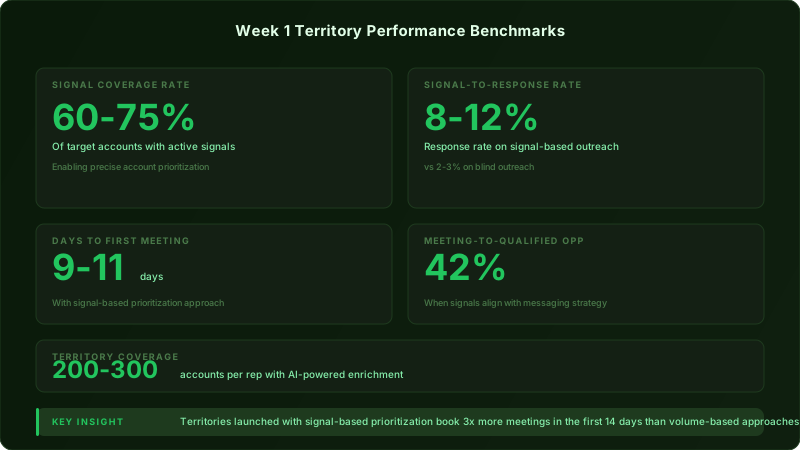
The Dashboard You Actually Need
Build a weekly dashboard with six numbers:
- Signal coverage: Percentage of target accounts with 1+ active signals
- Outreach sent: Emails, calls, LinkedIn touches (by signal tier)
- Response rate: Responses divided by outreach sent (by signal type)
- Meetings booked: Total meetings on the calendar
- Meeting-to-opp conversion: Qualified opps from meetings held
- Pipeline created: Dollar value of opps generated (even if early stage)
Review this every Monday. Adjust your approach based on what the data shows, not what you hope is working.
What to Do When Week 1 Doesn't Go as Planned
Sometimes the plan breaks. Here is how to fix it.
Diagnose low response rates. If you are under 5%, it is one of three problems: signal quality (you are targeting accounts without real buying intent), message relevance (your emails do not connect to their actual situation), or timing issues (you are reaching them during budget freeze, holiday slowdown, or internal chaos). Pull a sample of 20 non-responders and research them manually. What do they have in common? Adjust from there.
Pivot outreach strategy based on early data, not panic. If email is not working but LinkedIn connection requests are getting 20% acceptance, shift your effort. If short emails (two sentences) are booking more meetings than long ones (five sentences), simplify. Data tells you where to move, not gut feeling.
Expand or contract territory segments based on signal density. If your Tier 1 accounts (3+ signals) are only 50 accounts and you need more pipeline, expand the definition to include 2+ signals. If your territory is too large and you are spread thin, contract to focus only on the top signal-rich 100 accounts. Territory size is not fixed.
Adjust meeting qualification criteria if initial conversations reveal misalignment. I launched a territory targeting Series B SaaS companies and quickly realized my best meetings came from Series A companies scaling fast, not Series B companies in maintenance mode. I shifted my ICP definition by week two based on real conversation quality, not the original hypothesis.
Document lessons learned and create playbook updates. Keep a running document of what works: which signals, which messages, which personas, which objection responses. By day fourteen, you should have a territory-specific playbook that is better than the generic one you started with. Update it weekly.
On day fifteen, you should have 3-5 qualified meetings on your calendar, a pipeline of 10-15 engaged prospects in nurture, and a clear signal-driven playbook for the next 90 days. If you followed this sequence, you are not guessing anymore. You are executing a repeatable system.
The reps who miss quota in greenfield territories are the ones who skip week one intelligence and jump straight to volume outreach. They send 1,000 emails to random accounts and wonder why nothing converts. The reps who hit quota treat week one as the foundation. They build signal-driven lists, craft territory-specific messaging, and focus on accounts that are actually buyable.
Your next move: pull your target account list right now. Run signal enrichment on the top 100 accounts. Rank them by signal strength. Write three message variants tied to your top three signals. Send the first 20 emails tomorrow morning to your highest-signal accounts. Track the response rate. Adjust and repeat.
Greenfield territories are not guessing games. They are signal detection problems. Solve that first, and everything else gets easier.
Ready to See It in Action?
Get a free report with ~20 enriched leads tailored to your market. See what adaptive prospecting looks like before you commit.