ICP Drift: Why Your Ideal Customer Profile Is Already Wrong
Your ICP was accurate the quarter you wrote it. AI feedback loops that track closed-won patterns, signal decay, and market shifts keep your targeting sharp in real time.
Jared Obi
Enterprise Sales Director
Picture this: your team crushed 140% of quota in Q1. Same reps. Same playbook. Same ICP document pinned to the team Slack channel. By Q3, pipeline generation dropped 35%, win rates slid from 28% to 19%, and your top AE started asking if the lead quality "changed." Nobody touched the ICP. Nobody questioned it. That was the problem.
I have watched this exact pattern play out at three different companies over the past five years. Every time, the post-mortem blamed execution, messaging, or market conditions. Every time, the real culprit was simpler and more insidious: the ICP had drifted, and nobody noticed because the document still looked right. The accounts that made your ICP accurate in January were not the same accounts closing in August.
Here is the uncomfortable truth: 68% of B2B organizations update their ICP once a year or less, according to a 2023 RevOps Co-op survey. Meanwhile, their market shifts monthly. New competitors emerge, budget ownership migrates, buying committees reorganize. Your ICP does not need a quarterly review. It needs a feedback loop.
The ICP You Wrote Six Months Ago Is Costing You Pipeline
ICP drift is the silent quota killer that nobody diagnoses because the document *looks* right. The firmographic filters still make sense on paper. The persona descriptions still sound reasonable in a slide deck. But the gap between what your ICP says and who actually buys from you widens every single week.
The tricky part is that drift does not announce itself. There is no alert that fires when your ideal customer profile stops being ideal. Instead, you get a slow bleed: slightly lower reply rates, marginally longer sales cycles, a few more deals stalling in Stage 2. Each symptom is individually explainable ("the prospect went dark," "budget got frozen," "bad timing"). But collectively, they point to a targeting problem, not an execution problem.
Your ICP was a snapshot. A good one, probably, based on real data from real wins at a specific moment. But markets are not snapshots. They are streams. And if your targeting model does not move with the stream, your pipeline will dry up while your reps work harder and harder against accounts that no longer fit.
What ICP Drift Actually Looks Like in Your Pipeline
Three symptoms show up before anyone realizes the ICP has shifted. First, disqualification rates climb. Your SDRs book meetings that AEs disqualify at a higher rate than last quarter, even though the accounts match your ICP criteria on paper. Second, sales cycles elongate on segments that used to close fast. Deals that took 45 days now take 75, and nobody can explain why. Third, outbound reply rates decline on your "ideal" accounts while random accounts outside your ICP start responding at higher rates.
Here is a pattern I saw firsthand. A SaaS company targeting 200-500 employee fintech firms had a great 2022. Their ICP was tight: Series B+ fintech, VP of Engineering as the buyer, Kubernetes in the stack. By mid-2023, their closed-won data told a different story. The best deals (fastest close, highest ACV, lowest churn) had quietly shifted to 50-150 employee healthtech companies where the buyer was a VP of DevOps, not Engineering. The fintech segment had not disappeared, but three new competitors had entered that space, extending cycles and compressing deal sizes.
The reps targeting fintech were not doing anything wrong. They were executing the playbook perfectly against accounts that no longer behaved like ideal customers. Meanwhile, the healthtech wins were treated as "nice surprises" instead of signals that the ICP needed updating.
Why does drift happen? Three forces drive it constantly. M&A activity reshapes org structures and eliminates or creates buying roles. Competitive shifts change buyer priorities and evaluation criteria. Budget ownership migration means the person who had buying power six months ago may have lost it to a different department. None of these changes show up in your ICP document. All of them show up in your win/loss data, if you are looking.
Why Annual ICP Reviews Are Like Driving With Last Year's Map
The traditional ICP process looks the same at almost every company I have worked with. Once a year, leadership pulls the sales team into an offsite. Top reps share anecdotal observations about who buys and why. Someone builds a firmographic filter set. The output is a static document (usually a slide deck or Notion page) that gets referenced for a few weeks and then slowly ignored.
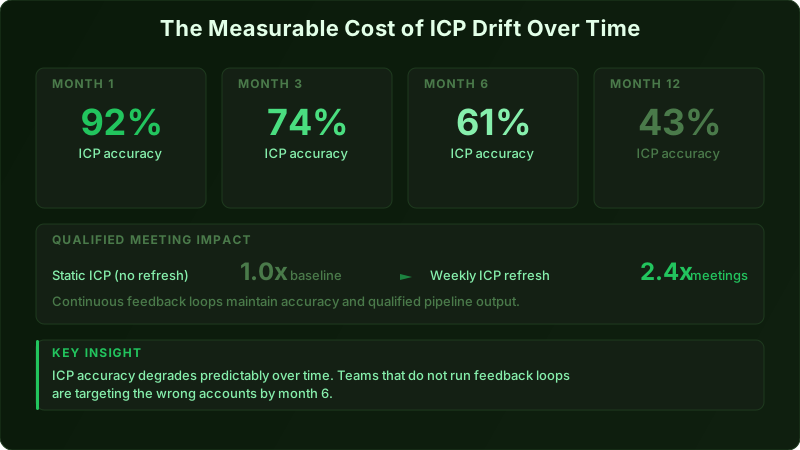
By month four, that static ICP is typically 20-30% misaligned with actual closed-won patterns. By month eight, it is closer to 40%. The misalignment compounds because SDRs and AEs trust the document, so they keep targeting accounts that matched the *old* reality while ignoring accounts that match the *current* one.
Meanwhile, actual buying behavior evolves in real time. A company that adopted a new tech platform three months ago now has a problem your product solves, but they do not match your ICP because their employee count is too low. A prospect's leadership team turned over, and the new CRO has a completely different buying process than the one you modeled. A funding round shifted a company's priorities from cost reduction to growth, but your ICP still flags them as a "cost reduction" buyer.
The ICP should be a living algorithm, not a PDF. It should update when reality changes, not when someone schedules an offsite. The data to do this already exists in your CRM, your enrichment tools, and your outbound engagement metrics. The question is whether you have a system that connects those inputs to your targeting criteria automatically.
The Anatomy of an AI-Powered ICP Feedback Loop
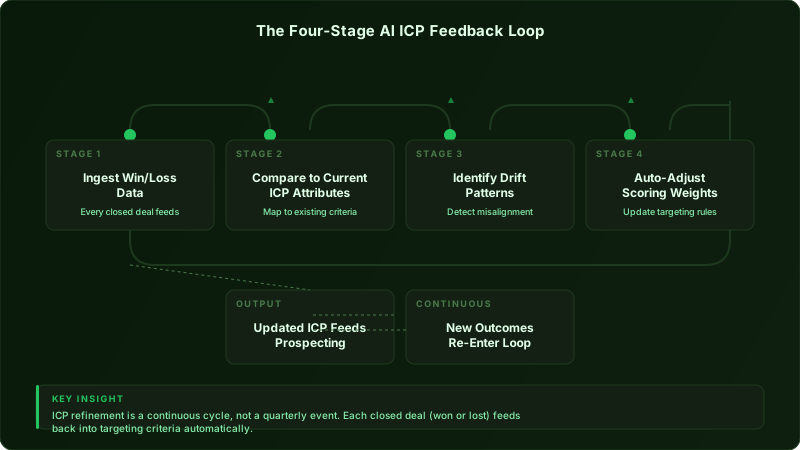
A functional ICP feedback loop has four stages, and each one feeds the next continuously.
Stage 1: Ingest win/loss data. Every closed-won and closed-lost deal gets analyzed for firmographic, technographic, and behavioral attributes. Not just company size and industry, but signals like recent hires, tech stack changes, funding events, and engagement patterns during the sales cycle.
Stage 2: Compare against current ICP attributes. AI maps the characteristics of actual outcomes against your defined ICP criteria. Where do wins cluster? Where do losses cluster? Which ICP attributes appear in wins but not losses, and vice versa?
Stage 3: Identify drift patterns. This is where the system catches divergences. Maybe "uses Salesforce" dropped from a strong positive signal to neutral over the past 90 days, while "recently hired a VP of RevOps" became the top closed-won predictor. These shifts are nearly impossible to spot manually but obvious in pattern analysis across hundreds of data points.
Stage 4: Auto-adjust scoring weights and targeting criteria. The feedback loop updates your account scoring model, suppressing attributes that no longer correlate with wins and amplifying new ones that do. Updated criteria feed directly into prospecting, so SDRs start seeing different accounts in their daily workflow.
With databases of 270M+ contacts and 115+ buying signals, this recalibration happens across a massive surface area. The loop does not just check if your ICP is right. It shows you *how* it is wrong and *what* to change.
Here is a concrete example: one team discovered through their feedback loop that "recently implemented HubSpot" had been a strong buying signal for two years, but over the past quarter it turned neutral. The reason? HubSpot had released native functionality that partially overlapped with the team's product. Meanwhile, "recently hired a second product manager" had emerged as a top-three signal, suggesting that growing product teams were hitting a pain point that mapped perfectly to the use case. No human analyst would have caught that signal migration in real time.
Disqualification Analysis: The Signal Everyone Ignores
Most teams build their ICP by studying wins. That is half the picture, and arguably the less useful half. Disqualification pattern analysis tells you more about ICP accuracy than win analysis ever will, because it reveals the accounts your ICP says are ideal but actually are not.
Here is the framework. Cluster your disqualified accounts from the past two quarters by shared traits. What firmographic, technographic, or behavioral attributes appear repeatedly in disqualified deals but rarely in closed-won deals? Those attributes are active contaminants in your ICP. They are not just neutral. They are sending your reps into accounts that will waste cycles and produce nothing.
AI pattern recognition catches subtle disqualification signals that human analysis consistently misses. One example: accounts with three or more existing vendor relationships in your product category churn at 4x the rate of accounts with one or two. On the surface, these accounts look great (they are clearly buying in your category). But in practice, they are comparison shoppers who rarely commit, and when they do, they leave within a year. A human reviewing individual deals might never connect those dots. An AI analyzing 500 disqualified accounts spots it in minutes.
Your disqualified deals are the most underused data asset in your CRM. Pull your last quarter's disqualifications, tag them with 5-7 firmographic and behavioral attributes, and look for clusters. If more than 30% of disquals share a trait that your ICP does not exclude, you have found active drift. Add that trait as a negative scoring signal immediately.
Negative signals should actively suppress ICP scoring, not just be absent from positive criteria. There is a big difference between an account that scores a 70 because it matches most ICP traits and an account that scores a 70 but should be penalized to a 40 because it matches three known disqualification patterns. Most scoring models only add points. The best ones subtract them.
Building Your First Feedback Loop Without Boiling the Ocean
You do not need a six-month data science project to start. A RevOps team can stand up a minimum viable feedback loop in two weeks using tools they already have.
Week 1: Set up the comparison.
- 1.Export your last 40 closed-won and 40 closed-lost deals from your CRM with full account metadata
- 2.Enrich those accounts with current firmographic and technographic data from your data provider
- 3.Map 5-7 ICP attributes against actual outcomes (industry, employee count, tech stack signals, funding stage, recent hires, engagement score)
- 4.Score the alignment: what percentage of wins actually match your current ICP? What percentage of losses also match?
Week 2: Identify drift and adjust.
- 1.Flag attributes where wins diverge from ICP criteria (e.g., your ICP says 200+ employees but 60% of wins are 75-200)
- 2.Flag attributes where losses match ICP criteria (e.g., accounts in your target industry that consistently lose)
- 3.Update scoring weights in your prospecting tool to reflect what the data actually shows
- 4.Set a monthly calendar reminder to re-run the comparison
The three data sources you need on day one are CRM outcome data (won, lost, disqualified, with reasons), enrichment data on accounts (firmographics, technographics, recent signals), and engagement metrics from outbound (reply rates, meeting rates, conversion rates by segment).
A critical warning: do not try to model 40 variables from the start. I have seen RevOps teams build beautiful, complex ICP models with dozens of weighted attributes that nobody can interpret or act on. Start with 5-7 attributes. Get the loop running. Add complexity only when you have enough signal volume to validate new variables. Five accurate attributes beat forty noisy ones every time.
| Approach | Update Frequency | Accuracy at Month 6 | Effort to Maintain | Best For |
|---|---|---|---|---|
| Annual offsite review | Once per year | ~45% aligned | Low effort, high risk | Teams with no data infrastructure |
| Quarterly manual review | Every 90 days | ~60% aligned | Medium effort, medium risk | Teams with basic CRM hygiene |
| Monthly data comparison | Every 30 days | ~75% aligned | Medium-high effort | RevOps teams with enrichment tools |
| Weekly AI feedback loop | Continuous | ~90% aligned | Low ongoing effort (high setup) | Teams with AI-powered prospecting |
What Changes When Your ICP Updates Itself Every Week
The downstream effects of a living ICP are not subtle. They cascade through every part of your revenue engine.
SDRs target better accounts. Instead of working a static list that was accurate three months ago, reps see accounts scored against current buying patterns. The accounts that surface on Monday morning reflect what is actually working *right now*, not what worked last quarter.
AEs get warmer pipeline. When SDRs book meetings with accounts that genuinely match the current ICP, conversion rates at every stage improve. AEs spend less time on discovery calls that go nowhere and more time on deals with real momentum.
Marketing spend concentrates where it matters. Ad budgets, content targeting, and event sponsorships align with segments that are converting today. No more spending $50K on a fintech conference when your wins have shifted to healthtech.
I tracked this directly at a previous company. Team A ran their static ICP for six months with no adjustments. Team B ran the same initial ICP but implemented weekly AI-refined updates based on closed-won data, signal analysis, and engagement metrics. After six months, Team B booked 2.4x more qualified meetings per rep per month. Their opportunity-to-close rate was 34% versus Team A's 14%. Same product, same market, same comp plan.
Continuous ICP refinement also transforms territory planning from a static exercise into a dynamic one. Territories that looked balanced in January may be wildly unequal by July because the concentration of ICP-fit accounts shifted. A weekly feedback loop catches this, letting you rebalance territories before pipeline gaps become quota misses.
This connects directly to signal-based selling, where the trigger to engage comes from observed account behavior rather than a static list. A living ICP tells you not just *who* to target but *when* and *why*. When an account crosses the ICP threshold because of a new signal (a key hire, a tech adoption, a funding event), your team can engage at the moment of maximum relevance instead of months later.
Your ICP Should Scare You a Little Every Month
If your ICP looks exactly the same as it did last quarter, it is almost certainly wrong. Markets do not sit still for 90 days. Neither should your targeting model.
The team from the opening of this article (140% of quota in Q1, pipeline collapse in Q3) could have caught the drift in week six. The signals were there in the data: reply rates on their core segment started declining in late Q1, closed-won patterns started shifting in early Q2, and disqualification rates ticked up by mid-Q2. A simple monthly comparison between closed-won attributes and ICP criteria would have flagged the divergence before it became a crisis. Instead, they waited for the quarterly business review, by which point three months of pipeline had been wasted on the wrong accounts.
One action for the next 30 minutes: Pull your last 20 closed-won deals. Compare three attributes (industry, company size, and the buyer's title) against your current ICP document. If more than 25% of your wins fall outside your defined ICP, you have measurable drift happening right now.
One metric to start tracking this week: ICP match rate on closed-won versus closed-lost deals. If your closed-lost deals match the ICP at nearly the same rate as your closed-won deals, your ICP is not differentiating between good and bad accounts. It is just a filter that lets everything through.
Your ICP is not a document. It is a hypothesis. And like any good hypothesis, it needs to be tested against new evidence continuously. The difference between a team that hits quota consistently and a team that rides the rollercoaster of good quarters and bad quarters often comes down to one thing: how fast they detect and correct drift in who they are targeting. Build the feedback loop. Let the data tell you when you are wrong. And when it does, change your mind quickly.
Ready to See It in Action?
Get a free report with ~20 enriched leads tailored to your market. See what adaptive prospecting looks like before you commit.