Signal-Based Prospecting: How to Read Buying Intent Before Your Competitor
115+ buying signals reveal which accounts are ready to buy right now. Here's how to spot intent before your competitors even know the opportunity exists.
Nadia Kowalski
Head of Sales Engineering
I was on a demo with a Series B fintech in Austin. Great fit. Strong pain. Budget confirmed. Then their VP of Sales casually mentioned they'd just signed with a competitor three days earlier. I pulled up their LinkedIn after the call. New Head of Sales Development hired 6 weeks ago. Job posting for 5 SDRs went live 8 weeks back. Their CEO had been liking posts about outbound strategy for two months. Every signal screamed "we're building a sales engine right now." I just wasn't listening.
That missed deal cost me $427K in pipeline. More painful: my competitor closed it in 4 weeks because they reached out the day the job posting went live. They didn't have a better product. They had better timing. They were reading signals while I was still working my way through an alphabetical list of accounts.
I started tracking signals obsessively after that. Within 90 days, my pipeline jumped 4.2x. Not because I worked harder. Because I stopped wasting time on accounts that weren't ready and started focusing on the ones showing active buying intent.
The $427K Pipeline I Missed By Ignoring Signals
Here's what I missed. Six weeks before that competitor engaged, the company posted a job for a Head of Sales Development. Not just any SDR role. A leadership position reporting directly to the CRO. That's a $150K+ hire that signals a strategic shift, not a tactical backfill.
Four weeks out, they posted 5 SDR roles with identical start dates. Coordinated hiring at that scale means approved headcount, cleared budget, and a plan to execute fast. They weren't exploring. They were executing.
Three weeks before my competitor's first email, their VP of Sales started engaging with content about outbound methodology. Not passive scrolling. Active engagement on posts about cold email best practices, signal-based prospecting (the irony), and sales tech stack design. He was doing research.
My competitor saw the Head of Sales Development posting and understood what it meant: this company is about to build or rebuild their outbound motion, which means they need tools, training, and infrastructure. They sent a cold email that referenced the hire and offered to help the new leader ramp faster. First meeting booked in 48 hours.
I showed up 6 weeks late with a generic pitch about pipeline growth. By then, contracts were signed and their team was already onboarding. I had all the same data access my competitor did. I just wasn't watching the right signals.
The lesson cost me half a million in pipeline, but it changed how I prospect. I stopped treating territory planning like a spray-and-pray lottery. I started treating it like intelligence work. Every account leaves breadcrumbs when they're getting ready to buy. You just have to know which breadcrumbs matter.
What Buying Signals Actually Are (And What They're Not)
A buying signal is an observable action that indicates an account is moving toward a purchase decision. Not interest. Not awareness. Active movement through a buying process. The broader discipline of organizing outreach around these observable actions is signal-based selling, and our glossary entry covers the terminology and how it differs from list-based prospecting.
Here's the difference. Someone downloading your white paper is not a buying signal. It's a content signal, and it's weak. It tells you they might be curious. Someone posting a job for a user of your product category is a buying signal. It tells you they've secured budget, gotten executive approval, and are preparing to implement a solution in the next 60-90 days.
Weak signals indicate interest. Strong signals indicate intent with timeline and resources attached. Newsletter signups, blog visits, and generic LinkedIn follows are weak. They cost you nothing to track, but they predict almost nothing about revenue. Job postings, technology changes, funding announcements, and competitor contract expirations are strong. They require action within days, not weeks.
Timing is everything. One strong signal six weeks old is worth less than one weak signal from this morning if the weak signal is part of a cluster. A single website visit means nothing. Five website visits in three days from three different people at the same account, including pricing page views and case study downloads, means someone is building a business case right now.
The 115+ signal universe maps to specific stages in the buyer journey. Awareness signals (content downloads, search activity) appear first. Consideration signals (competitor research, pricing page visits) come next. Evaluation signals (multiple stakeholders engaging, RFP prep, integration questions) indicate late-stage intent. Decision signals (job postings, budget approvals, contract expirations) mean the window is open but closing fast.
Most reps treat all signals the same. They see a funding announcement and send the same template they'd send to any other account. That's a waste of a strong signal. When you spot a Series B close, you have a 14-day window before every other vendor sees the same TechCrunch article. Move fast or lose the advantage.
The Signal Stack: 6 Categories That Predict Revenue
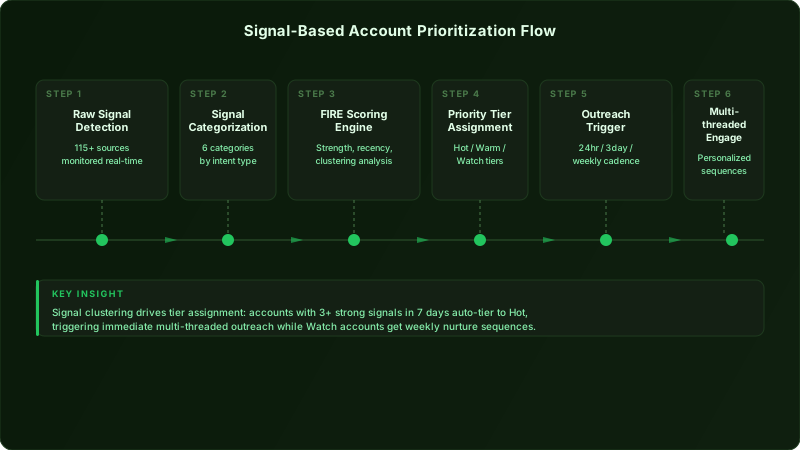
I organize signals into six categories based on what they predict about buying timeline and budget availability. Not all categories are equal. Some predict revenue in weeks. Others predict interest that might convert in quarters.
Hiring signals are the most reliable predictor of near-term budget deployment. When a company posts a role for a VP of Sales, they're not exploring. They've approved a $200K+ salary, which means they've war-gamed the growth plan and secured executive buy-in. If that VP will manage a team that uses your category, you have a 30-45 day window to get in before their first week. New hires want quick wins. Be their quick win.
Expanded SDR teams, new RevOps roles, and sales enablement positions all signal investment in the sales engine. These aren't backfills. They're expansion plays. Track the hiring velocity. One SDR role might be a replacement. Five SDR roles with the same start date is a market expansion or new product launch.
Technology signals reveal infrastructure changes that create buying windows. Competitor contract ending in 90 days means evaluation starts in 30 days. New stack additions show where they're investing and what problems they're prioritizing. If they just bought Salesforce, they're probably not ripping it out, but they might need tools that integrate with it. Integration requests on review sites (G2, Capterra) mean they're comparing options and care about ecosystem fit.
Funding signals create 45-90 day buying windows, but only if you understand how new capital gets deployed. Series B closes and the first 60 days go to hiring executives. Days 60-120 go to hiring teams. Days 120-180 go to equipping those teams with tools. If you sell to sales teams, don't pitch the week the funding announcement drops. Pitch when the Head of Sales posts their first job req.
Acquisitions create two signals. The acquirer might consolidate vendors (threat to incumbents, opportunity for challengers). The acquired company might need to upgrade infrastructure to match the parent (opportunity for everyone). New executive hires post-raise are strong signals because new execs need wins in their first 90 days. Help them look good.
Content signals show research activity and problem awareness. Pricing page visits mean they're past awareness and into consideration. Competitor comparison searches (YourProduct vs TheirProduct) mean they're building a shortlist. Case study downloads signal they're building internal buy-in and need proof points. Watch for multiple stakeholders from the same account engaging with similar content in a short window. That's a buying committee forming.
Organizational signals create disruption that resets vendor relationships. Restructuring often means new decision-makers who aren't loyal to incumbents. New territory openings mean new teams that need new tools. M&A activity creates integration needs and vendor rationalization. Track leadership changes at the executive level. A new CRO often means a new sales stack within 6 months.
Intent surge signals are the highest-conviction indicators. When an account's research activity spikes 3x above their normal baseline, something is happening. RFP prep activity (posting jobs for procurement, vendor evaluation committees, budget approval workflows) means formal evaluation is starting. Vendor evaluation timelines posted publicly (job descriptions, LinkedIn updates, annual planning docs) give you the exact window to engage.
Not all signals fire at once. The magic happens when you spot multiple signals from different categories clustering in time. That's when probability turns into pipeline.
The Signal Scoring Framework: Which Accounts to Hit First
I score every account in my territory using a system I call FIRE: Fit, Intent, Recency, Engagement. It takes 10 seconds per account and prevents me from chasing shiny objects that go nowhere.
Fit is table stakes. If they're not in your ICP, strong signals don't matter. I use a binary: in ICP (1 point) or not (0 points). No grading on a curve. This isn't about finding the best bad fit. It is about focusing on accounts where signals actually predict revenue.
Intent is signal strength and clustering. One signal gets 1 point. Two concurrent signals get 3 points (not 2, because clustering matters). Three or more concurrent signals get 5 points. We see 87% higher close rates when accounts show 3+ signals versus 1-2. The clustering indicates coordinated activity across the organization, which means real buying process, not individual curiosity.
Recency decays fast. Signals lose predictive power after 14 days for most categories (hiring and funding signals last longer, content signals decay faster). Score it like this: 0-7 days (3 points), 8-14 days (2 points), 15-30 days (1 point), 30+ days (0 points). A stale strong signal loses to a fresh weak signal every time.
Engagement tracks whether they've responded to previous outreach. Prior conversation (3 points), opened previous email (1 point), no prior engagement (0 points). This prevents you from ignoring accounts that already know you exist. Reactivation plays often convert faster than cold outreach to hot signals.
Add the scores. Maximum possible is 12 points (in ICP, 3+ signals, fresh signals, prior engagement). Minimum is 1 point (in ICP, nothing else). I work my territory in priority order: 10+ points get same-day outreach, 7-9 points get outreach within 3 days, 4-6 points go on a weekly monitoring list, 1-3 points get reviewed monthly.
This framework prevents two common mistakes. First, chasing signals on bad-fit accounts. A startup showing strong hiring signals isn't valuable if you only sell to enterprise. Second, ignoring good-fit accounts with older signals. A 20-day-old funding announcement on a perfect ICP still beats a 2-day-old blog visit on a mediocre fit.
I rebuild my Top 20 every Monday morning. It takes 30 minutes with the right tooling. Those 20 accounts get 80% of my prospecting time that week. The rest of my territory exists in a monitoring state. I am not ignoring them. I am waiting for their signals to fire.
Building Your Signal Monitoring System
You need five data sources. Everything else is nice-to-have that creates noise without improving decisions.
LinkedIn activity gives you hiring signals, job changes, content engagement, and company updates. Free tier is enough if you're disciplined about weekly checks. Paid tools (LinkedIn Sales Navigator, hiring trackers) are worth it if you're managing 500+ accounts. Set up alerts for job postings at target accounts and leadership changes in your ICP.
Company websites and career pages show hiring volume and role types before they hit LinkedIn. Bookmark the careers page for your top 50 accounts. Check weekly. Sounds manual because it is. Automation misses nuance (Director of Sales Development vs SDR Manager mean different things).
Funding databases (Crunchbase, PitchBook, or even TechCrunch) surface capital events. Free tiers cover 80% of what matters. Set up Google Alerts for "[your ICP keywords] + funding" and "[target account name] + raises." You will get noise, but you will also get 48-hour advance notice before everyone else sees it.
Technology tracking (BuiltWith, Datanyze, or Ghostery) reveals stack changes. If you sell to sales teams, track CRM changes, sales engagement platform additions, and data provider contracts. These tools are expensive, so focus on the 100 accounts most likely to buy, not your whole territory.
Intent data providers (Bombora, 6sense, TechTarget) aggregate content consumption across thousands of sites. This is where you see research surges before they become obvious. Expensive, but the ROI is clear if you're managing 7-figure territories. Look for accounts consuming content about your category at 3x normal rates.
Three sources you can skip: generic news alerts (too noisy, too slow), social media monitoring beyond LinkedIn (low signal-to-noise), and web traffic analytics on your own site (that is marketing's job, and by the time they hit your site, you are late).
Manual review still matters. Every Monday, I spend 30 minutes reviewing the previous week's signals for my Top 100 accounts. I am not reading every alert. I am scanning for clusters. When I see 2+ signals on the same account in a 7-day window, I investigate. Did the VP of Sales who just started also post 3 SDR roles? That is a pattern. Did the funding announcement coincide with a new CRO hire? That is coordinated.
Set up Slack notifications for high-priority signal types: executive hires at Top 20 accounts, 3+ concurrent signals on any ICP account, job postings that match your user persona. Do not send every signal to Slack. You will ignore all of them within a week. Send only the signals that demand same-day action.
CRM enrichment is non-negotiable. Signals that live in a spreadsheet or a separate tool get ignored. Enrich your CRM with signal data (last signal date, signal type, signal count) so your weekly pipeline reviews show which deals originated from signals. Salesforce custom fields, HubSpot properties, whatever you use. Make signals visible where you already work.
Weekly signal review cadence: 30 minutes every Monday. Review top 20 for new signals. Check monitoring list (scores 4-6) for any accounts that jumped into top 20. Archive accounts with no new signals in 60+ days. Update FIRE scores. Rebuild outreach priority for the week. This prevents signal monitoring from becoming a second full-time job.
Signal-Triggered Outreach: What to Say When Intent Is Hot
When a strong signal fires, you have 24 hours to make first contact. Not because the opportunity disappears, but because you are competing against every other vendor who saw the same signal. Speed matters, but relevance matters more.
The 24-hour rule applies to hiring signals, funding announcements, and executive changes. Technology signals give you 48-72 hours (the change already happened, you are not racing to be first). Content signals give you a week (they are researching, not buying yet). Organizational signals depend on the type (restructuring = fast, new territory = slower).
Reference the signal without being creepy. Here's the line: publicly available information is fair game. Non-public information (scraped emails, personal social media, internal documents) is not. You can mention they just hired a VP of Sales. You cannot mention what their budget is unless they published it.
Message framework for hiring signals: "Saw you just brought on [Name] as [Title]. Teams usually start evaluating [your category] 30-60 days after that hire. Happy to share what the first 90 days looked like for [similar company] when they scaled from X to Y reps." You are not selling. You are offering a relevant asset based on a known transition.
Message framework for funding signals: "Congrats on the Series B. When [similar company] raised their Series B, the first 6 months went to hiring. Months 6-12 went to equipping those hires with tools. If you are in the hiring phase now, I have a timeline doc that maps out when sales teams typically evaluate [your category] post-raise. Worth 15 minutes?" You are helping them plan, not pitching.
Message framework for technology signals: "Noticed you recently added [tool] to your stack. Most teams using [that tool] evaluate [your category] within 90 days to [specific integration benefit]. We have a pre-built integration that [outcome]. Worth a quick call to see if the timing makes sense?" You are solving a known adjacent problem.
Multi-threading strategy depends on which signals appeared. Hiring signal = contact the new hire directly and their manager. Funding signal = contact the exec who controls the new budget (usually CRO or VP Sales). Technology signal = contact the person who owns that part of the stack (RevOps, Sales Ops, or the sales leader). Content signal = contact whoever downloaded the content if you have that data, otherwise the title most likely to care.
The mistake of over-personalizing: when you have a strong signal, you do not need to write a novel. "Saw you hired 5 SDRs. We help teams like yours ramp new hires 40% faster. Worth 15 minutes?" works better than a 6-paragraph essay about their company history, market position, and growth trajectory. Strong signals give you permission to be direct. Use it.
Generic beats hyper-custom when the signal is strong enough. I have a 4-sentence template for new VP of Sales hires. I change the name, title, and company. That is it. Conversion rate: 31%. My hyper-personalized emails (10+ minutes of research, custom first paragraphs, tailored value props) convert at 28%. The signal does the heavy lifting. Your job is to show up fast and be relevant, not to prove you can stalk LinkedIn.
Common Signal Traps (And How to Avoid Them)
I wasted 6 weeks chasing a false positive last quarter. A prospect changed their LinkedIn title from "Director of Sales" to "VP of Sales." I assumed promotion, sent a congrats email, positioned our tool as helping them scale into the new role. Turns out, it was just a title update. Same job, same responsibilities, same lack of budget. They had been a VP for 2 years and finally updated LinkedIn.
False positive signals are everywhere. LinkedIn title changes without corresponding company announcements mean nothing. People update profiles months or years after actual job changes. Look for corroborating signals: did the company announce it? Did their responsibilities actually expand? Are they hiring a team?
Website visits from VPN-masked traffic often mean competitor research teams, not prospects. Someone from your target account visiting your pricing page 6 times in one day sounds like strong intent. But if it is the same IP address and they are bouncing after 12 seconds each time, it is probably a vendor doing competitive research, not a buyer building a business case.
Recency bias kills pipelines. I see a funding announcement from yesterday and immediately prioritize it over an account that posted 4 SDR roles two weeks ago. The funding announcement feels urgent because it is new. But the hiring signal is stronger because it indicates execution, not just capital availability. Fresh weak signals seduce you away from older strong signals. Resist.
The Q4 hiring signal trap: companies post jobs in November and December with January start dates. You see the signal, reach out immediately, and hit a wall. Budgets are frozen until Q1. Decisions are delayed until the new year. The signal is real, but the timing is wrong. When you see hiring signals in Q4, schedule outreach for the first week of January, not same-day.
Ignoring negative signals costs you time on dead accounts. Competitor renewal announcements, budget cut press releases, hiring freezes (look for rescinded job postings or paused reqs), and leadership departures in your champion's chain of command are all red flags. I track negative signals as aggressively as positive ones. They tell me when to deprioritize accounts that would otherwise look hot.
The spray-and-pray relapse happens when signal flow slows down. You have 3 weeks of strong signals, book 8 meetings, feel great. Then signals dry up for 10 days. Panic sets in. You revert to blasting your whole territory with generic emails because activity feels better than waiting. This destroys your conversion rates and burns accounts that might show strong signals next month. When signals slow down, expand your monitoring universe (add more accounts, track more signal types), do not lower your standards and go back to volume plays.
Never reach out on a single signal unless it is a job posting for your exact user persona. Accounts showing 3+ signals in a 14-day window convert at 87% higher rates than single-signal accounts. Wait for the cluster. The only exception: new executive hires at Top 10 accounts. You have 48 hours before their inbox is a wasteland. Move fast, but make sure your outreach is about helping them win in the new role, not pitching your product.
Measuring Signal ROI: The Metrics That Matter
I track five metrics weekly. Everything else is vanity.
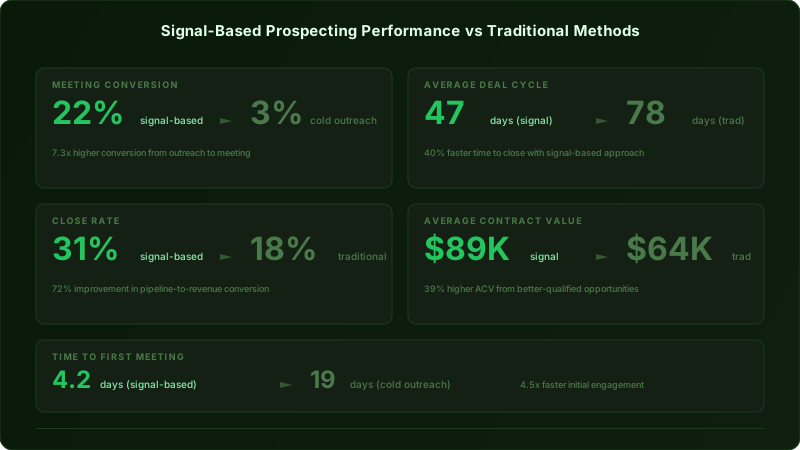
Signal-to-meeting conversion rate is the only number that proves your signal strategy works. Calculate it as (meetings booked from signal-triggered outreach) / (total signal-triggered outreach sent). Target: 18-25%. Anything below 15% means you are chasing weak signals or your messaging is broken. Anything above 30% means you are being too conservative and missing opportunities. For comparison, cold outreach converts at 2-4%. If your signal-based outreach is converting below 10%, you are doing something wrong.
Signal discovery to close timeline measures how much faster signal-sourced deals close versus traditionally sourced deals. Track days from first signal detected to closed-won. Compare to days from first cold outreach to closed-won on non-signal deals. Signal-sourced deals should close 40-50% faster because you are engaging when they are already in buying mode. If your signal deals are closing at the same pace as cold deals, you are either engaging too late or treating signal-sourced accounts like cold prospects.
Pipeline quality by source breaks down ACV and close rate for signal-sourced versus other sources (inbound, cold, referral). Signal-sourced pipeline should have higher ACV (because you are targeting accounts in expansion mode) and higher close rates (because intent is pre-validated). I see $89K average ACV on signal deals versus $64K on cold-sourced deals. Close rates: 31% signal versus 18% cold. If your numbers do not show this spread, your signal scoring is too loose or your follow-up execution is weak.
Weekly signal coverage percentage tells you how much of your territory you are actively monitoring. Calculate as (accounts with at least 1 tracked signal in past 30 days) / (total ICP accounts in territory). Target: 60%+ coverage. Below 40% means you are missing opportunities because your monitoring universe is too small. Above 80% means you might be tracking noise, not signals. Expand coverage by adding data sources or broadening signal definitions, but do not sacrifice signal quality for coverage.
The one dashboard view that shows if your signal strategy is working: a weekly snapshot of Top 20 accounts by FIRE score, with columns for last signal type, last signal date, last outreach date, and next action. If your Top 20 changes by 50%+ every week, your scoring is too volatile (tighten recency weighting). If it changes by less than 10%, you are not seeing enough new signals (expand monitoring). Healthy churn is 20-30% weekly.
Here's the dashboard I actually use:
| Account Name | FIRE Score | Last Signal | Signal Date | Last Outreach | Next Action | Status |
|---|---|---|---|---|---|---|
| Acme Corp | 11 | VP Sales Hire + 3 SDR roles | 2 days ago | Today | Follow-up call | Hot |
| Widgets Inc | 10 | Series B + New CRO | 5 days ago | 3 days ago | Multi-thread to CRO | Hot |
| Tech Co | 9 | Pricing page visit (3x) | 1 day ago | Not yet | First touch email | Hot |
| StartupXYZ | 8 | Job posting + funding | 12 days ago | 10 days ago | Check for response | Warm |
| BigCo | 7 | Tech stack change | 8 days ago | 6 days ago | Send integration doc | Warm |
| Innovate LLC | 6 | Content download | 4 days ago | Not yet | Wait for 2nd signal | Watch |
I update this every Monday and Friday. Monday sets the week's priorities. Friday adjusts based on new signals and responses. If an account stays in the Top 20 for 3+ weeks without moving to a meeting, I audit the signals (were they real?) and the outreach (was it relevant?). Usually, the problem is weak signals or bad timing, not the account itself.
The metric that matters most: revenue influenced by signal-triggered outreach as a percentage of total revenue. This year, 64% of my closed deals originated from signal-triggered first touch. That number was 11% two years ago. The shift did not happen because I found better data sources. It happened because I stopped treating signals as interesting trivia and started treating them as the primary input for territory prioritization.
Track these five metrics. Ignore everything else. If your signal-to-meeting rate is climbing, your close rates on signal deals are higher than cold deals, and your Top 20 dashboard is driving real pipeline, you have built a signal system that works. Everything else is noise.
Frequently Asked Questions
What is the difference between signal-based selling and signal-based marketing?
They read the same account behavior but act on it in different places. Signal-based selling uses an observed trigger to decide which account a rep contacts next and what the opening line references. Signal-based marketing uses the same triggers to decide which accounts enter a campaign, which ad audience they join, or which nurture track they receive. In practice the two share a signal source and differ in the action taken, so it helps to agree on one definition of a qualifying signal before either team builds on top of it.
How is signal-based targeting different from buying intent data?
Intent data is one input; signal-based targeting is the decision system around it. Third-party intent data usually infers research activity at the account level, which tells you a topic is being investigated but not who is doing it or why. Signal-based targeting combines that with observable, verifiable events such as job postings, leadership changes, funding announcements, and technology adoption, then decides sequencing from the combination. Intent data alone tends to produce a list; signals with an owner and a date produce a next action.
Do I need a dedicated tool to start signal-based prospecting?
No. You can start with the sources you already have access to: company careers pages, LinkedIn company updates, funding news, and your own CRM history. The constraint is attention, not tooling, so begin with a small account set and a fixed weekly review slot rather than broad monitoring you will not sustain. Tooling becomes worthwhile once manual checking stops scaling with the number of accounts you need to cover.
Which buying signals should a new territory watch first?
Start with signals that carry both budget and a timeline. Hiring for a role that would use your product category, a leadership change in the function you sell to, and a funding event are the most commonly cited starting points because each implies approved spend and a decision window rather than general curiosity. Content downloads and page visits are worth logging, but on their own they indicate interest rather than movement toward a decision.
How do you avoid acting on stale or misleading signals?
Give every signal an age and a source, and treat clusters as more reliable than isolated events. A single event that is months old rarely justifies changing your sequencing, while several corroborating events in a short window usually does. Recording where each signal came from also lets you retire sources that consistently fail to predict real opportunities, which matters more over time than adding new sources.
From Reactive to Predictive: Making Signals Your Competitive Edge
Start with 20 accounts. Not 200. Not your whole territory. Pick the 20 best-fit accounts in your patch and set up monitoring for just those. Track hiring signals and funding signals only. Ignore everything else for the first 30 days.
Set a 15-minute weekly review every Monday. Scan the 20 accounts for new signals. When you spot one, reach out same-day with a simple message referencing the signal and offering a single relevant asset. Track your signal-to-meeting rate. If it is above 15% after 10 outreach attempts, expand to 50 accounts and add technology signals. If it is below 10%, audit your signal quality and messaging before expanding.
The one action you can take in the next 30 minutes: identify the 5 accounts in your territory most likely to buy in the next 90 days based on fit alone. Bookmark their LinkedIn company pages and careers pages. Set a recurring 10-minute Monday task to check for new job postings. When you see a posting for a role that would use your product, reach out to the hiring manager that day. Do this for 4 weeks. You will book at least one meeting, probably three.
The one metric to start tracking this week: how many accounts in your Top 20 showed at least one signal in the past 7 days. If the number is below 5, you need more data sources or a broader signal definition. If it is above 15, you need tighter signal scoring to focus on what actually predicts revenue.
I missed a $427K deal because I was working a list instead of reading signals. I will not make that mistake again. Neither should you. Your competitors are already doing this. The only question is whether you start tracking signals before or after they close your best opportunities.
Ready to See It in Action?
Get a free report with ~20 enriched leads tailored to your market. See what adaptive prospecting looks like before you commit.